
Most homeowners think insulation is the thing that makes a house comfortable.
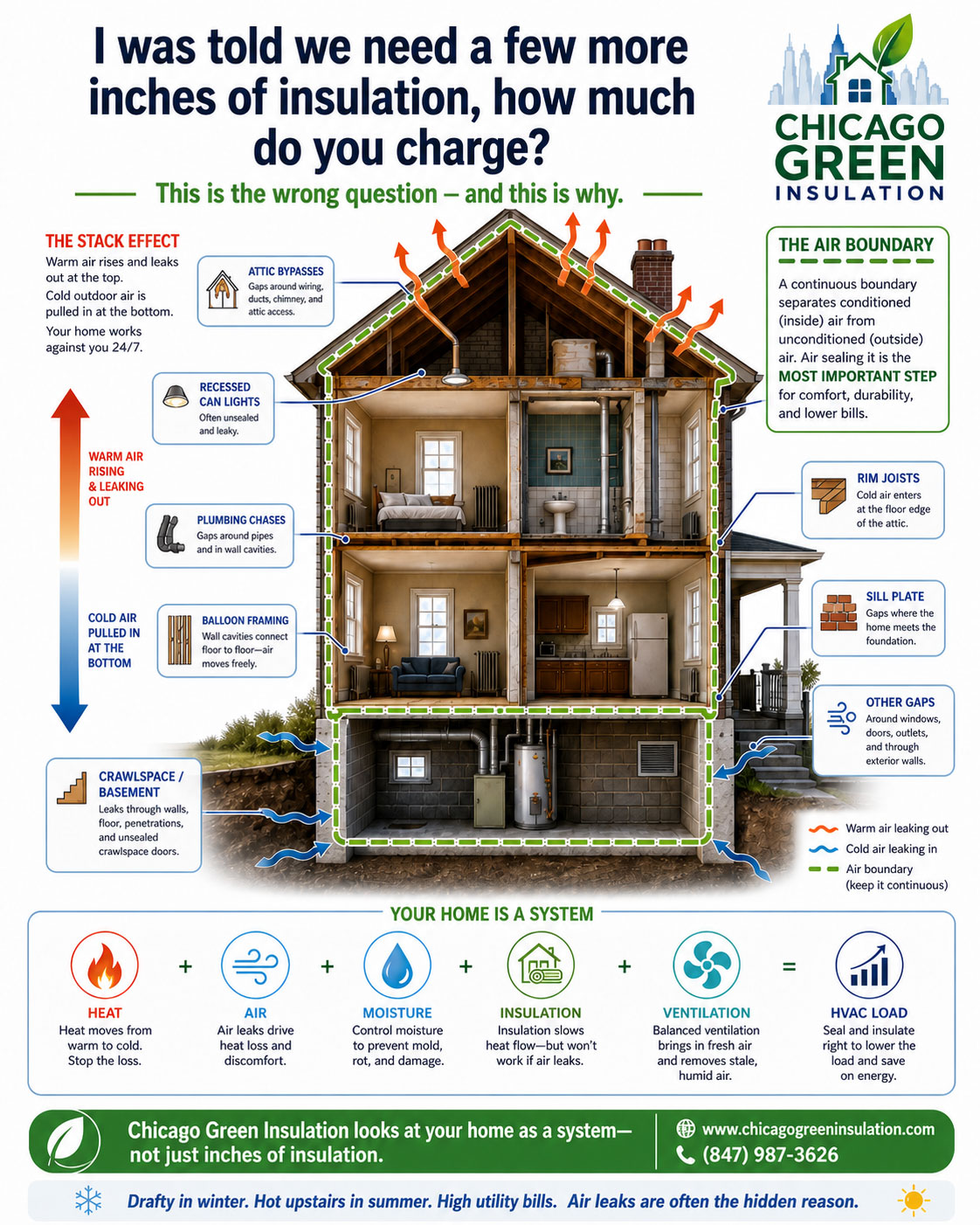 It is, but only if the air is controlled first.
That is the part most people miss.
Insulation slows heat transfer. Air sealing stops air movement. Those are not the same thing. You can have a deep blanket of insulation (Air Filter that catches all the dust leaving and entering your home via the attic or Walls – that’s why it turns from yellow/ pink to brown or black) in your attic and still have a house that is cold in the winter, hot upstairs in the summer, dusty, drafty, uncomfortable, and expensive to heat and cool.
Why? Because insulation does not stop air from leaking through holes.
In building science, we measure that leakage with a blower door test. The number we often look at is ACH50, which means “air changes per hour at 50 Pascals of pressure.” In plain English, it tells us how many times the air inside the house is replaced by outside air when the house is subjected to test pressure.
Older Chicago-area homes are often very leaky. It is not unusual to see older homes test around 15 to 20 ACH50. That means the house is not just losing a little bit of air. It is constantly exchanging conditioned air with outdoor air through gaps, cracks, attic bypasses, can lights, plumbing chases, balloon framing, rim joists, crawlspaces, and poorly sealed mechanical openings.
That air leakage matters more than most people realize.
Every cubic foot of warm air that escapes out the top of the house in winter has to be replaced by a cubic foot of cold air being pulled in from somewhere else. That is the stack effect. The house acts like a chimney. Warm air rises, leaks into the attic, and cold air gets pulled in low through the basement, crawlspace, rim joist, sill plate, walls, and any other weak spot it can find.
So when a homeowner says, “My furnace runs all the time, but the house still feels cold,” the problem may not be the furnace.
When they say, “My second floor is unbearable in summer,” the problem may not be the air conditioner.
When they say, “I have ice dams every winter,” the problem may not be the roof or gutters.
Very often, the real problem is uncontrolled air movement through the structure.
This is why simply adding more insulation is not always the answer. If you blow R49 cellulose over an attic floor without sealing the air leaks first, you may improve the R-value number on paper, but the house may still leak like crazy. Air can still move through the insulation. Warm, moist indoor air can still enter the attic in winter. Hot attic air can still communicate with the living space in summer. The homeowner may spend money and still wonder why the house does not feel the way they expected.
 A better approach starts by asking: where is the air boundary?
In a traditional vented attic, the air boundary should be at the attic floor. That means sealing top plates, can lights, plumbing penetrations, bath fan openings, chimney chases, duct penetrations, dropped soffits, and other bypasses before adding insulation.
In a spray-foamed roofline or unvented attic, the strategy changes. The air boundary moves from the attic floor to the roof deck, gable walls, and exterior top plates. That is why the scope of work has to make sense as a system. You do not want to sell random attic-floor air sealing as the main event if the roofline itself is becoming the new air boundary.
The goal is not just “more insulation.”
The goal is a smaller, tighter, better-defined box of air.
That is where ACH50 becomes useful. If a house starts around 15 to 20 ACH50, it is a very leaky house. If we can move it toward 10 ACH50 with better attic work and selective air sealing, the homeowner may feel a real difference. If a more comprehensive air-sealing and insulation strategy can move the house toward 3 ACH50, we are now talking about a dramatically different building.
At that point, the heating and cooling equipment does not have to fight the house all day. Rooms become more even. The second floor becomes easier to control. The furnace runs less. The air conditioner has a better chance of reaching the set point. Humidity becomes easier to manage. Dust and drafts are reduced. Ice dam risk can decrease because less heat escapes into the attic.
This is also why bigger HVAC equipment is often the wrong first answer. A bigger furnace or bigger air conditioner may mask the problem for a while, but it does not fix the building. In many older homes, the smarter path is to reduce the load first. Tighten the house. Improve the insulation. Define the air boundary. Then size the mechanical system to the improved structure, not to the old, leaky version of the house.
Insulation matters. R-value matters. But R-value without air sealing is only part of the story.
A comfortable home is not created by insulation alone. It is created by controlling heat, air, and moisture together.
That is the building science answer.
 With ten years of experience selling spray foam insulation in Chicago, Tom Decker is THE person to call and the Chicago Green Insulation is the organization to hire when you are looking for top notch quality and performance as well as someone who can deal with the needs of code officials, home owners and general contractors. Call the others in Chicago, if you are interested in the cheapest price, call Chicago Green Insulation if you are interested in using your dollars to make Chicago a better city for all of us!


 Chicago Green Insulation
 Chicago Green Insulation
 Chicago Green Insulation
 Chicago Green Insulation

 Chicago Green Insulation
 Chicago Green Insulation