
Summer Home Comfort in Chicago: Buddy Guy Is Not the Only One with the Blues
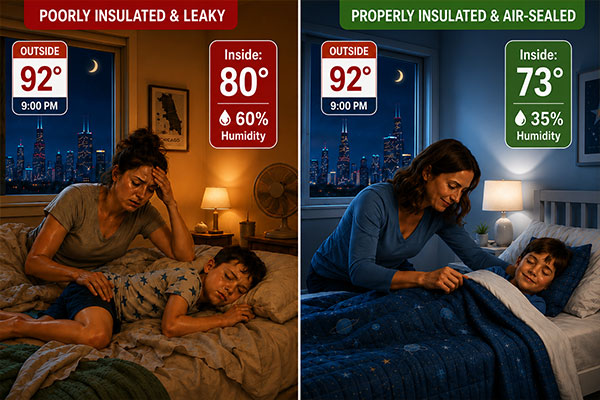 Every summer, homeowners from Rogers Park to Beverly, from Pullman to West Garfield Park, and from Oak Lawn, Elmhurst, Hinsdale, Evanston, Skokie, Oak Park, Berwyn, Glenview, Highland Park, and the western suburbs deal with their own version of the same Chicago blues: one part of the house feels fine, while another room feels hot, sticky, and impossible to cool.
Sometimes it is the second floor of a classic Chicago bungalow. Sometimes it is the top unit of a brick two-flat, three-flat, or Greystone. Sometimes it is the upstairs bedroom in a Cape Cod, the second floor of a Georgian, the attic space in an American Foursquare, the back bedroom in a ranch home, or an addition that never seems to cool like the rest of the house.
The homes are different, but the complaints sound familiar: “The AC runs all day.” “The first floor is freezing, but the bedrooms are still hot.” “The top floor never catches up.” “The house feels sticky.” “One room is always uncomfortable.”
Buddy Guy may have made the blues famous in Chicago, but homeowners do not need to live with the summer comfort blues inside their own homes.
The problem is usually not that your air conditioner is too small. More often, the problem is the house the air conditioner is trying to cool.
Chicago has a beautiful housing stock, but many of these homes were built long before today’s comfort expectations, central air systems, smart thermostats, and rising energy costs. The details vary by house style, but the building science is usually the same: air leakage, poor duct performance, attic heat gain, crawlspace or garage exposure, humidity, weak return air, and restricted airflow.
For Chicago bungalows, Cape Cods, Georgians, and American Foursquares, the problem is often attic heat, knee walls, leaky ceiling planes, can lights, attic hatches, and upstairs rooms sitting directly under a hot roof. For ranch homes, the issues often include long duct runs, weak returns, rooms at the far end of the system, attic heat above, or crawlspace and basement conditions below. For two-flats, three-flats, and greystones, the top-floor unit usually takes the biggest hit from roof and attic heat, while lower units may struggle with duct leakage, shared chases, humidity, and air moving between units.
That is why lowering the thermostat usually does not fix the problem. If one part of the home is 8 to 10 degrees warmer than another, the AC may run longer, the cooler rooms may get too cold, and the problem rooms may still feel uncomfortable. In a better-performing home, the difference between rooms or floors should often be much smaller, sometimes as little as 2 degrees.
There are also a few things homeowners can do right away. Open interior doors during the day whenever possible, especially bedroom doors. Keep the HVAC fan circulating air during the active parts of the day. Make sure supply registers and return vents are not covered by beds, rugs, dressers, toys, laundry, or anything else that tends to collect in kids’ rooms. You cannot cool a room properly if the air you pay to cool cannot get into the room or back out.
Start with airflow. Decorative wood floor registers may look nice, but many restrict airflow compared with properly sized metal registers. If a bedroom is already at the end of a duct run, that restriction matters. Keep rugs, beds, curtains, and furniture away from vents. Make sure return vents are open. Do not close multiple vents to “force” air elsewhere. That can raise static pressure, reduce system performance, and make the equipment work harder.
 On hot Chicago summer days, using the HVAC fan strategically can help. Running the fan about 45 minutes per hour during the day can mix air between rooms and reduce hot and cold pockets. This is especially useful in two-story homes, top-floor units, ranch homes with long duct runs, and homes where heat stacks upstairs. But do not run the fan constantly in humid weather if the AC is not actively cooling. A wet evaporator coil can re-evaporate moisture back into the air, making the house feel stickier.
Humidity is one of the biggest summer comfort problems in Chicago-area homes. A house at 78 degrees with lower humidity can feel better than one at 72 degrees with higher humidity. Short AC cycles are often part of the problem. The system cools the air quickly but does not run long enough to remove moisture. Smart thermostats, properly adjusted equipment, dehumidification, and better air sealing can all help the home feel more stable and comfortable.
Attics are another major source of summer discomfort. Powered attic fans sound helpful, but in many homes, they can pull conditioned air out of the living space through ceiling leaks, can lights, bath fan gaps, attic hatches, and wall cavities. The better solution is usually to air-seal the ceiling plane, improve attic insulation, and ensure bath fans vent outside, not into the attic.
Duct leakage matters too. If ducts are leaking in an attic, crawlspace, garage, or basement, a large percentage of the air you pay to cool may never reach the rooms that need it. Leaky returns can also pull humid, dusty, or dirty air into the system. Duct sealing, AeroSeal, and better return pathways can often improve comfort without replacing the AC.
Crawlspaces matter in summer, too. Spraying foam only under the floor may reduce some drafts, but it does not fully protect ducts, plumbing, framing, or the living space from crawlspace humidity and temperature swings. The better approach is usually to seal and insulate the crawlspace walls and rim joist so that the ductwork and plumbing are brought into a more controlled environment.
The bottom line: summer comfort in Chicago is not a single product, and it is not always a larger air conditioner. It is airflow, air sealing, duct performance, attic control, crawlspace control, humidity control, and smart fan operation working together.
Before spending thousands on new HVAC equipment, fix the house the equipment is trying to cool.
Chicago Green Insulation serves every neighborhood and community in Chicago and the surrounding suburbs, helping homeowners solve the real problems behind hot rooms, sticky bedrooms, uncomfortable second floors, top-floor apartments, ranch homes, bungalows, Cape Cods, Georgians, two-flats, three-flats, Greystones, crawlspaces, attics, and additions that just do not feel right in summer.
If your home has the summer comfort blues, call Chicago Green Insulation. We help fix the house, not just blame the air conditioner.
 With ten years of experience selling spray foam insulation in Chicago, Tom Decker is THE person to call and the Chicago Green Insulation is the organization to hire when you are looking for top notch quality and performance as well as someone who can deal with the needs of code officials, home owners and general contractors. Call the others in Chicago, if you are interested in the cheapest price, call Chicago Green Insulation if you are interested in using your dollars to make Chicago a better city for all of us!


 Chicago Green Insulation
 Chicago Green Insulation
 Chicago Green Insulation
 Chicago Green Insulation

 Chicago Green Insulation