
How to Make Your House More Comfortable in Winter and Summer (DIY Fixes That Work)
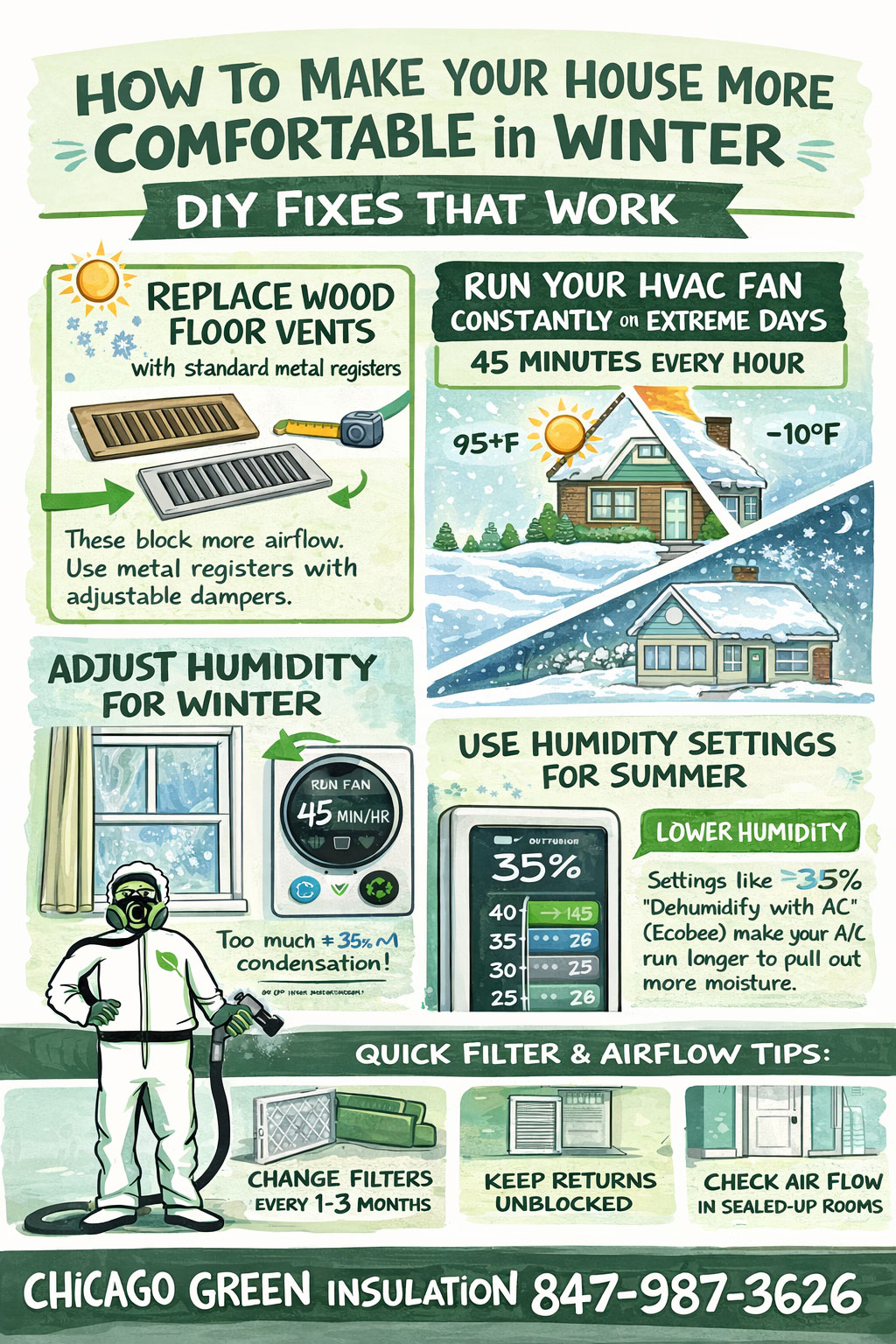 If your house feels hot and uneven in summer and drafty or hard to heat in winter, you don’t necessarily need new HVAC equipment. Most comfort problems stem from a few fixable issues: restricted airflow, poor air mixing, and unmanaged humidity for the season. Here are DIY improvements that work, especially in two-story homes.
Replace decorative wood floor vent covers with standard metal registers
Wood floor grille covers often look nice, but many of them restrict airflow compared to standard metal registers. Less airflow means weaker cooling upstairs in summer, colder rooms at the end of duct runs in winter, and a greater temperature difference between floors.
DIY steps:
Remove the wood grille (usually held in by screws).
Measure the duct opening (common sizes: 2×10, 4×10, 4×12, 4×14).
Install a metal register, ideally with an adjustable damper.
Keep rugs and furniture from blocking the opening.
Don’t fully close multiple vents to try to force air into other rooms. Over-closing registers can raise static pressure and reduce overall system performance. Use small adjustments only.
Run the HVAC fan for 45 minutes every hour on the hottest and coldest days
On the hottest days of summer and coldest days of winter, comfort problems get worse because the air is stratified. Hot air collects upstairs in summer. Cold air settles downstairs in winter.
A simple DIY strategy is to run the blower about 45 minutes per hour from your first cup of coffee until you turn off the lights at night. This improves comfort by mixing air, reducing hot and cold pockets, and evening out temperatures between floors, often without changing your thermostat setpoint.
When not to do this:
If you have a damp basement and your system pulls basement air, extra fan runtime can spread humidity.
If you suspect leaky ducts in an attic or crawlspace, extra fan runtime can amplify those losses.
How to set 45 minutes per hour on a standard thermostat
If you don’t have a smart thermostat, switch the fan from AUTO to ON on extreme-weather days and back to AUTO before bed. That’s the simplest way to increase air mixing when you need it most.
Nest fan schedule
In the Nest app, go to Fan, choose Fan Schedule, and set the fan to run for a high portion of each hour during the hours you’re awake. Use this mainly on extremely hot or cold days rather than year-round.
Ecobee minimum fan runtime
On Ecobee, go to Main Menu, Settings, System, Fan. Set the Minimum Fan Runtime Per Hour to 45 minutes and apply it during the hours you’re awake on extreme days. Ecobee will coordinate fan runtime with heating or cooling calls.
Summer humidity: use humidity control settings to let the AC run longer
Sticky summer discomfort is often caused by humidity, not just temperature. Air conditioning removes the most humidity when it runs longer. Short on-off cycles cool the air but don’t remove as much moisture.
On Ecobee, enable the Dehumidify Using AC setting (wording may vary). This allows slightly longer cooling cycles so the system can remove more moisture.
Nest humidity features are more limited, but the same principle applies. Aim for longer cooling cycles rather than frequent short cycles.
Some smart thermostats may allow the temperature to drift 1–2 degrees below your setpoint to keep the AC running long enough to dehumidify. Drier air feels cooler and more comfortable.
If your goal is to reduce humidity, avoid running the fan constantly by itself during very humid weather. Running the fan without cooling can re-evaporate water off the coil and reduce overall humidity removal.
Winter humidity: keep it low enough to prevent condensation
In winter, too much indoor humidity can cause window condensation and even hidden moisture problems. A practical guideline:
Around 30 degrees outside: 35 to 40 percent relative humidity.
Around 20 degrees: 30 to 35 percent.
Around 0 degrees: 25 to 30 percent.
Below 0 degrees: 20 to 25 percent.
If your windows are wet or frosting, lower indoor humidity and improve air circulation.
Quick airflow checks that cost little
Replace filters regularly, but avoid overly restrictive filters if airflow is already weak.
Keep return vents unblocked.
If a room is uncomfortable, check whether closing the door traps air. A lack of a return path is common in bedrooms.
Bottom line
If your home is uncomfortable in both January and July, start with DIY improvements that target airflow, air mixing, and humidity. Replacing restrictive floor registers, running the fan strategically, and using smart thermostat humidity features to encourage longer AC run times can make a noticeable difference quickly, without replacing
 With ten years of experience selling spray foam insulation in Chicago, Tom Decker is THE person to call and the Chicago Green Insulation is the organization to hire when you are looking for top notch quality and performance as well as someone who can deal with the needs of code officials, home owners and general contractors. Call the others in Chicago, if you are interested in the cheapest price, call Chicago Green Insulation if you are interested in using your dollars to make Chicago a better city for all of us!


 Chicago Green Insulation
 Chicago Green Insulation
 Chicago Green Insulation
 Chicago Green Insulation

 Chicago Green Insulation